Showing posts with label Kenya. Show all posts

Wednesday, October 1, 2014

Kenya's Mountain Lodge


Although I haven't been blogging lately, a friend of mine has recently returned from  South Africa, and her photos served to remind me how much of my heart I left on that continent. I thought I might do a series of posts to highlight the wonderful lodges we stayed at in the course of our safari...

 My husband and took a photo safari through Kenya and Tanzania eight years ago.This trip remains one of the true highlights of my life. I felt immediately at home with the golden savannahs that stretched on forever, and the hot sun that loosens tight muscles and seems, indeed, to slow down time itself. 


 Our first stop after leaving Nairobi was the Mountain Lodge. Mount Kenya is in the highlands of Kenya, so shrouded in mist that when we were there, I was only able to capture a shadowy shot of the mountain itself.
It is simply a magical place. The
lodge is wrapped around a waterhole that abounds with animals day and night.

(Google photo: We weren't allowed out there!)

Arriving just before dark, we found hot water bottles 
nestling in the cold beds to bid us welcome.


Sleep was the last thing we were thinking about. Each room has its own private balcony with a view of the waterhole and its visitors. Sitting there watching Elephants and Cape Buffalo wander in to drink, the rest of the world ceased to exist for me. 

With the shuffling of hooves and splashing water the only sounds to be heard, we could sit quietly and watch the animals go about their evening as if we were not there. It was a privilege to do so. 


Management informed us they 
could awaken us in the night if the more elusive animals showed up. As soon as the pre-dawn knock sounded on our door, I rushed out to our balcony and watched a leopard lap warily at the waterhole. 

I did not take a picture for fear of disturbing him in any way. It was one of the two very brief times we were to see a leopard on our safari. 

I may have no shots to show for it but my mind can instantly conjure up the long, tense lines of this striking predator who soon fled that open space for the safety and visibility afforded by the tall trees.


Monkeys are prevalent in Africa. Although undeniably cute, they are considered pests, and tourists are directed to discourage them. 


As well as viewing the animals from above, the lodge features an underground tunnel leading to a viewing room with tiny barred windows at ground level. It is wonderful to see the wildlife close up, though a somewhat dubious pleasure in the case of the very homely Marabou Stork!


The next day we were led on a walk through the forest, escorted by armed guards,one in front, one in the rear - rifles slung over their shoulders and fingers at the ready.  

We grew accustomed to their presence in East Africa.The guards protect tourists from possible animal attacks, but are also vital in the control of poachers whose ruthless greed is reducing the herds of African wildlife to alarming low numbers.
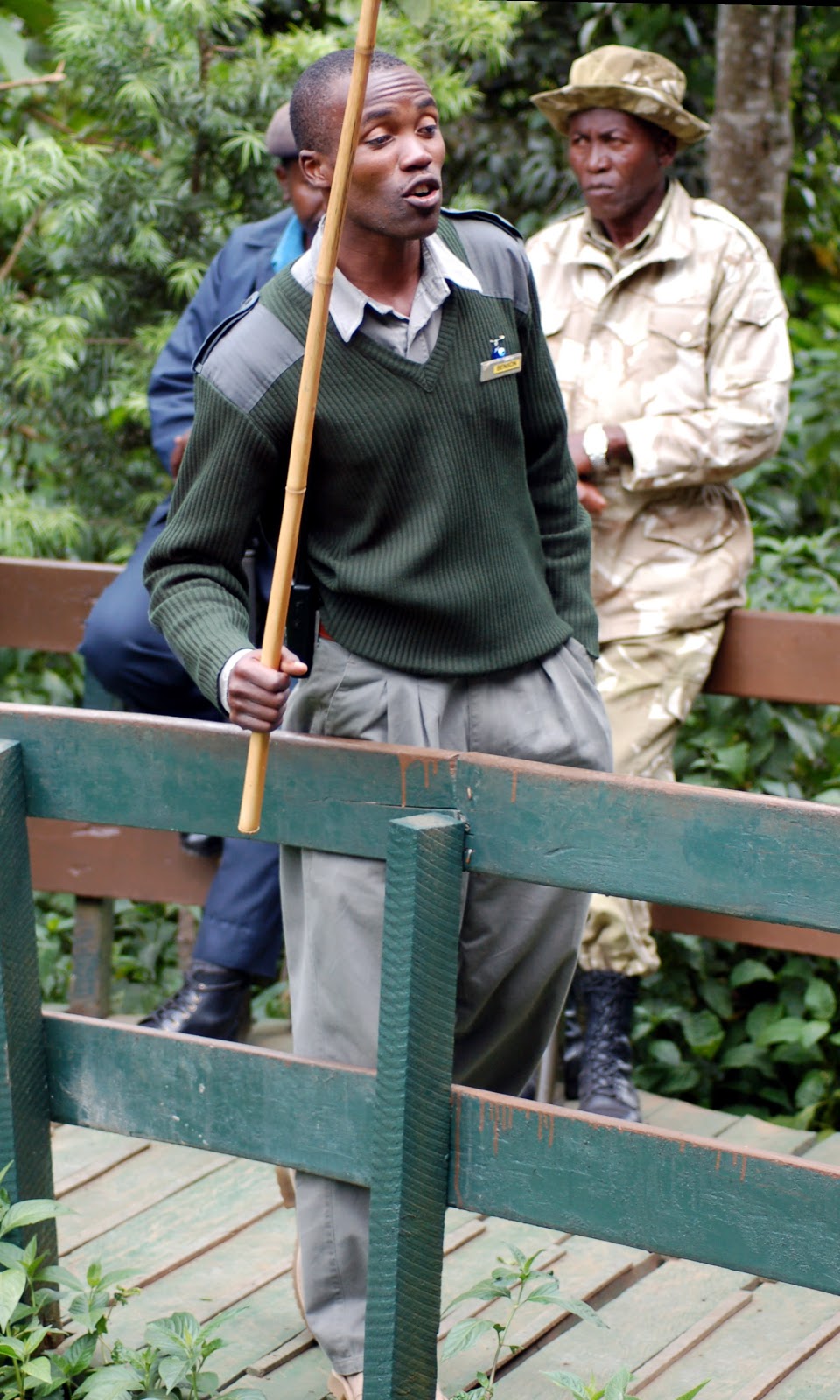

On this hot sunny day, we were also advised to cover up well, with trousers tucked into boots. The wisdom of that became clear when mosquitoes  swarmed around us and ants flooded over our feet in great numbers. Although tiny, these siafu have huge pincers that can inflict great pain upon reaching bare skin.


After walking for 
a while, we came 
to a clearing, and 
were delighted 
to see that tea 
had been set 
out for us. 

Sipping Earl Grey 
from a china cup and 
nibbling thin biscuits 
in the heart of an 
African forest is 
only one of the 
many lovely 
memories I took 
home with me. 


I strongly suspect no other afternoon tea I partake of will quite compare with this one... 


Next time, I'll take you to Kenya's Samburu Game Reserve.

Wednesday, October 31, 2012

P is for Photography


"The camera is an instrument that teaches people how to see without a camera".

Dorothea Lange
Photographer/photojournalist 1895 - 1965
.

I see my world through the photographs I make of it. Here are a few of my African favourites...

Desert Rose, Kenya

Elephants at Baobab tree, Tanzania
   
 Wildebeest, Masai Mara Game Reserve, Kenya

Cheetah, Masai Mara Game Reserve, Kenya

Agama Lizard, Masai Mara Game Reserve, Kenya

                      Rim of the Ngorongoro Crater, Tanzania
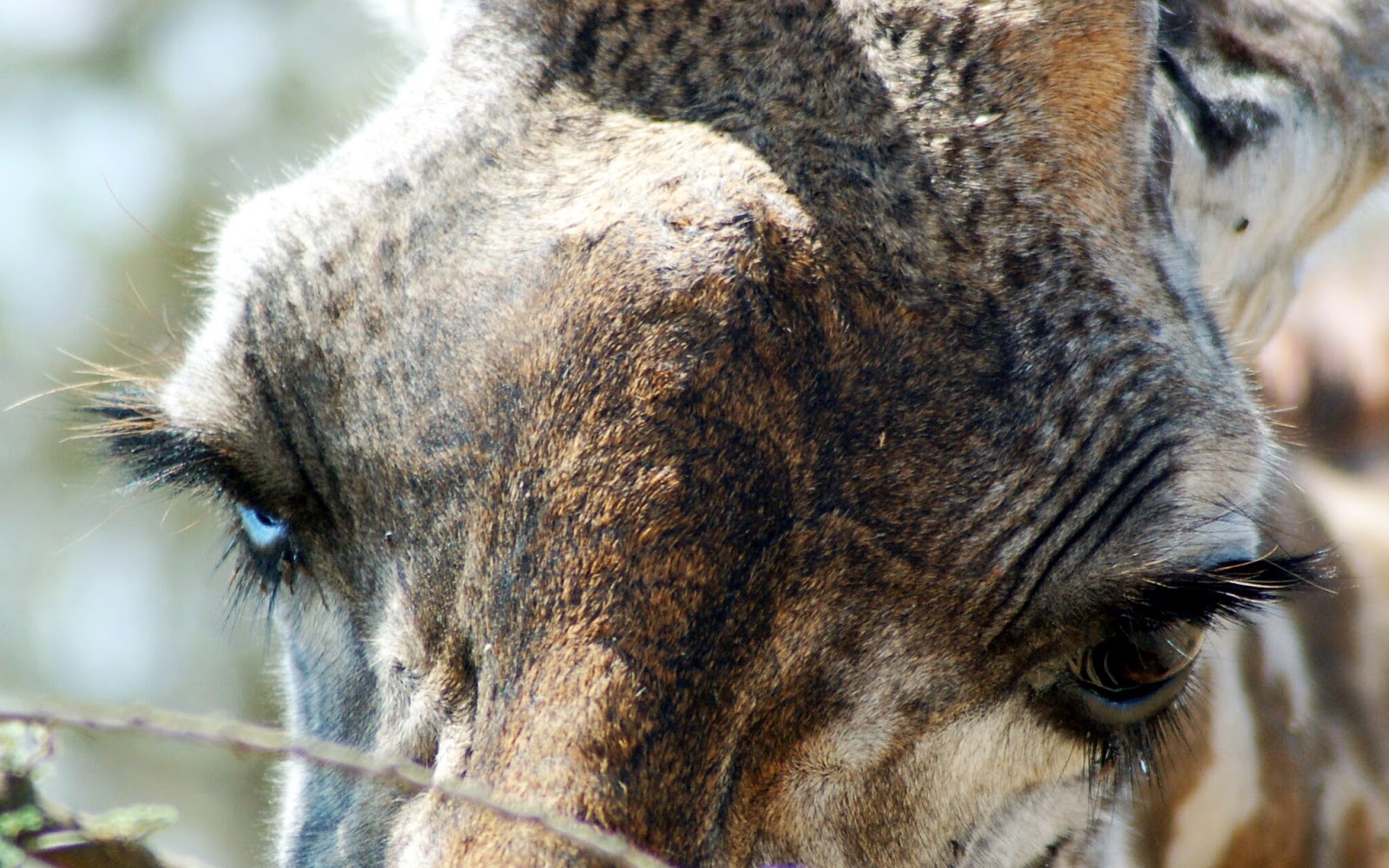
Giraffe, Masai Mara Game Reserve, Kenya

Gerenuk, Serengeti Plain, Tanzania

                            Young lion, Serengeti Plain, Tanzania

Masai village children, Kenya


I am linking this post to ABC Wednesday, and suggest you drop by and check out other takes on the letter'P'...


.


Thursday, October 25, 2012

O is for Olduvai Gorge


Africa's Olduvai Gorge is considered one of the most important paleoanthropological sites in the world. It is located in the Eastern Serengeti in Northern Tanzania, within the Ngorongoro Conservation Area.


The Gorge is a long ravine, forming part of Africa's Great Rift Valley. This Rift Valley stretches from the Red Sea through East Africa to the southern end of Mozambique and is characterized by uninhabitable desert and fertile farmland, flat arid plains and steep escarpments. It is also the only major land feature on earth visible with the naked eye from the moon.

 The name is an early misspelling of Oldupai Gorge, which was adopted as its official name in 2005. Oldupai is the Masai word for the wild sisal that grows there.

Over time, a series of fault lines, along with centuries of erosion, has revealed fossils and remnants of early humankind in Olduvai Gorge, which have been instrumental in furthering the understanding of human evolution.


Excavations in the early twentieth century by the famous archaeologist, Dr Louis Leakey, uncovered some of the earliest remains of fossil hominids at Olduvai. 

Seventeen years after the first discovery of human forms, Leakey’s wife, Mary, discovered the unmistakable fossilized footprints of a human ancestor who had walked along a riverbank three million years ago.


Skull of extinct giraffe


Since then, excavators 
working in Olduvai have 
found skeletal remains 
of a number of 
ancient hominids, 
including Homo habilis, 
Homo erectus and 
Australopithecus Boisei.


The Monolith


This archaeological evidence convinced most paleontolgists that humans originally evolved in Africa, and led to Olduvai Gorge being dubbed "The Cradle of Mankind'.


We came upon Olduvai in 2006  as we made our way from the Masai Mara in Kenya to Tanzania's Serengeti. 

When our driver stopped at a small, shabby museum, we were surprised by its simplicity...it  
seemed an unlikely holder of this area's rich history.


 Seated on small benches overlooking the Gorge, we listened attentively as a native guide explained the significance of the site.
It was only when we were leaving that I realized not all in our group were impressed. The two twenty-something girls with us rolled their eyes in boredom and asked why we'd stopped to look at "a big hole in the ground". Having never heard of the Leakey family or of Olduvai Gorge, and being unable to follow the guide's broken English, it must have seemed an odd thing to be sitting there, indeed.


Never underestimate the importance of context!


We shared our picnic lunch with a number of tiny birds that occupy the site.


I am linking this post to ABC Wednesday, and suggest you drop by and check out other takes on the letter'O'...


.

Friday, April 22, 2011

The A - Z April Challenge: S

For today's letter S, I offer more amazing African birds...
.
S is for Secretary Bird
.
The Secretary bird is a large terrestrial predator, with an eagle-like body on crane-like legs. It is one of the few birds who prey on foot, feeding on insects, lizards, snakes and small birds. These birds do not hunt larger herbivores, although there have been reports of them killing young gazelles.
.
In mongamous pairs, they prowl for food on the savannah most of the day, covering as much as twenty miles. Just before dark, they return to the safety of their roosts high in the thorny acacia trees.
.
The Secretary bird has traditionally been admired for its striking appearance and ability to deal with pests. In South Africa, they are sometimes kept in captivity to destroy snakes and rats. As a result of this tolerance, they are in little threat from humans but are adversely impacted by deforestation and loss of habitat. 
.
The Secretary Bird is the National Emblem of Sudan and is prominently featured on the South African Coat of Arms.
.
.
S is also for Superb Starling
.
. 

Also not threatened with extinction are the Superb Starlings, found in great numbers in East Africa, especially in Kenya. Glossy and bright with distinctive white eyes, they are easy fellows to spot.
.
These photos were taken just outside our cabin at the Samburu National Reserve, an altogether fine thing to see first thing in the morning as they come down to bathe in the ornamental pools.
Though it has a most discordant call, its wonderful colours and ease of training makes this Starling a popular bird for home aviaries. The white bands you see around the chest, indicate that they are adults.
.
Superb Starlings generally inhabit wooded areas and grasslands, but have clearly adapted well to human settlement.
.
.
For more A - Z posts, be sure to pop by Arlee Bird's site and see what others have done with the letter S...
.
http://www.tossingitout.blogspot.com/2011/01/very-special-and-exciting

Tuesday, April 19, 2011

The A - Z April Challenge: P

Africa boasts many treasures among its wildlife, not the least of which is the rich array of birds that populate the continent. For today’s A – Z Challenge, I offer two of them…
.

P is for Pelican
.
.

Great White Pelicans are large birds that look awkward on land, but are powerful and regal when flying in spectacular V-formations.


.
Their pouches serve as scoops to gather up the large quantities of fish they consume each day. Because of overfishing, they are often forced to fly great distances to find food.
. 

Great White Pelicans at Lake Nakuru with a sea of flamingos in the background
.

Human encroachment, pollution and loss of habitat are contributing to the decline of the Great Whie Pelican. People exploit this bird in many ways. Their pouches are used to make tobacco bags, their skin is turned into leather and the fat of young pelicans is converted into oils used in traditional Asian medicine.
.
Humans are the pelican’s greatest threat…
.
.
P is also for Plover
.

.
The striking Blacksmith Plover is found in the wetlands of Kenya and Tanzania. This bird’s numbers have actually been bolstered by the presence of humans as they’ve expanded into areas where dams are built and farms established
.
They feed on insects, worms, snails and mollusks. An opportunistic forager, the plover also plucks parasites from the backs of reptiles as they bask in the sun, and will even enter the mouth of a crocodile to pick remnants of food from between its teeth or leeches from the lining of its mouth.
.
For more A - Z posts, be sure to pop by Arlee Bird's site and see what others have done with the letter P...
.
.
.
.
.
.